Read Aloud Series, Book 3: Clementine

Book 3, Clementine

This petite book by Marla Frazee shows that girls can be Bad Kids, too. Clementine is wildly distracted and wildly creative and caring and silly and so youthful and innocent. She is a little bit manic pixie dream girl, but in a mostly harmless and very childlike way. Because Clementine is a child. She makes so many mistakes and is so much herself that through the opening chapters the kids at first are confused by her:  cutting off all her friend’s hair, then her own, then trying to fix it with red permanent marker, eating peas with a toothbrush, naming her pets after cosmetics products. Clementine also deals with loss and longing in a way that gently opens that conversation for the kids. It’s very silly and also disarming and real. 

Clementine creates a way into building curiosity and patience for a character, into experiencing the truth of the narrative before the protagonist does, and then waiting to see when and how she finally catches on. It sheds some light on how to love our friends and family members, even the most maddening ones, with generosity and curiosity. It shows how we can treat a Bad Kid with gentleness and acceptance and humor. Because we all make mistakes, and we have all wished to be embraced for who we are, and not just tolerated.  

The Read Aloud Series is a review of the series of books I used to read aloud to my third grade students every year after lunch. The exact order and titles changed somewhat over the years, but these are the ones that were most beloved, both for the kids as listeners and for me as the read aloud reader. Many afternoons our 15-minute read aloud time would stretch into 20, 30, sometimes as long as 45 minutes, as the kids begged to hear more of a story, or we discussed what a character did, or I reread difficult passages, or diagrammed family trees and plot lines for them. I can say that my gift as a teacher was, and still is, my enthusiasm for a good story, and these are the books that have brought me a great deal of joy in sharing with young readers over the years. 

on the process, week of Jan 15-21

I have not written about Annabelle, but I’ve thought about her. she is stuck, like a bug on pins or flattened between panes of glass. but I see her moving, despite the pressure of pins and glass, and she’s coming back to me. I don’t usually like to use first person in a fictional story, and that’s what’s making me shy to start again, so I will have to allow it and become comfortable with it, because I think that’s what the story calls for. 

I surprised myself by starting a new piece on Sunday — it’s about skin — and I drafted a couple of poems last weekend. it seems disingenuous to report that all these ideas are coming at me so effortlessly and that I’ve just got to open my laptop or grab a pen to catch them all on paper. but it felt a little bit like that with what I started today. maybe having a prompt helps. that’s what I had for the piece on skin. also, I decided to stay away from social media all day. unsurprisingly, it’s the calmest and most content I’ve been in days and days.

the lack of mental static is delicious. I must plan to repeat it, a day away from the online noise.

so we are approaching each other little by little, Annabelle and I. maybe I will force a final push this coming week, one with a prompt and a day without social media. why not? these stories won’t write them selves. 

on the process, week of Jan 8-14

back to work, and there is less time to be, or it feels that way. 

at work:  so much creation – of space and tasks and ideas and solutions to problems I never even anticipated arising. 

at work:  so many people, so much energy spent externally, the volume turned up much higher. and that is fine. I do not like to be only alone, only quiet. but it makes hearing the quieter voices, the softer nudges, the gentler pulls, harder to notice and follow. 

everyday presents the choice to choose habit or intention. habit is temptingly easy, intention much harder. 

I am intending to choose intention, even in small things:  quiet until after breakfast; noticing the light changing during the day, how it falls across the floor, then the wall, then away; sweeping the floor and chopping vegetables as meditation and not chores; looking for new beauty in a face I already know; this weekly reflection. 

and I must confess:  this weekly reflection was intended to be about a longer work, a book that started forming four years ago, but it has wandered so far away I’ve had to do dishes in silence and shovel snow in the cold to find a way to invite it back. 

and I must confess again:  I am through the foothills and at the base of the mountain, I think. I know where it will go, the book — if things go well — but I have to start over, nearly. what I thought would be a story told in limited third is asking to be told in first person. so. I have to sift through those pages, bravely, and let them go and move them into something new. again. re-creation. 

so. I intend to make time to sit at a window or at my desk and watch the light change, and also reread pages and smile and say hello and goodbye and hello, to start again. 

Self Care in 2019: Balance, Balance, Balance!

Yes, yes, of course. Self care is quite the catch phrase lately, so much so that at this point I feel like its actual meaning has been replaced with a pop culture meaning, which is spend lots of money on things like spa days or brand name items and give yourself permission to ignore other people’s needs in the name of putting yourself first.

I’m not against spa days or buying brand name items, and I’m not against putting ourselves first sometimes, but this pop version of self care is a disguise and a ruse that makes us believe that by spending money or neglecting other people we’ll feel better. And many of us will — but fleetingly — and at what price? The pop version of self care is a hollow way of taking care of yourself.

But in 2019, I’m going to focus a lot more on self care — or simply taking care of myself — and to do that, I am seeking the magic ingredient:  balance. Balance in everything:  my work life, my social life, my home life, my inner life, my health, all of it as much as I can. And it’s going to be hard. Because to be balanced, truly balanced, is nearly impossible.

     Balance is ephemeral, a moment of suspended grace.                                                      It’s not a permanent position, but it’s one worth striving for.

Balance — or an attempt at balance — requires self-awareness, self-forgiveness, optimism, and even a sense of humor. Because I know with my achiever tendencies I’ll want to “Be Balanced” right away and I’ll want to feel like I’m doing it right and making the right decisions all the time. But that’s the beauty — and the difficulty — of balance. There’s no one way to do it, and the path to balance transforms day to day.

One day balance may mean listening to a friend, really listening, with that still attentiveness and no agenda other than to be there. Another day it may mean taking on the center of attention while retelling a hilarious story. One day it may mean pushing myself really hard at a work out and one day it may mean staying home to rest. It may mean working till 9pm on Tuesday and leaving right on time to go out with a friend on Wednesday. It’s tricky. It’s unpredictable. Whatever it is it’s an approach at walking through life, not as a person frozen in perfect balance — whatever that would look like! — but as a living being responding to the world and her own inner voice and doing her best to make adjustments in loving, good humor.

The Achiever on Vacation

As an Achiever (see previous blog post for details) vacations can be hard on me. Sometimes space opens up and the clouds lift and I’m able to just be, to just relax. More often that doesn’t happen, or happen for very long, and I’m back to thinking, “What have I even done on this break?” Because, you  know, how can you lord over someone how relaxed you are — there’s no winning in that, you’re too relaxed!

That said, one good way for an Achiever to find a little balance is by reframing their achievements and focusing on the achievements in a non-work task or activity. So for this winter break I wanted to accomplish the following:  1. Read everyday, 2. Exercise six times (yes that’s very specific — but trust me — complex calculations took place before deciding on six), and 3. Be in the moment at least once a day.

I’m happy to say that I’m well on my way to achieving the crap out of this vacation. And to celebrate, I’m going to list a few of my smaller accomplishments.

  • Watched the entire Twilight series over the course of two days — eventually my eyes started to hurt but it felt good to just sit and revel in a guilty pleasure
  • Sat in a cafe and read The Sun cover to cover — so good!
  • Played Let’s Go Fishin’ with family members on Christmas Eve — things got intense with the grown ups
  • Tried a new recipe for Christmas Day — delish!
  • Yoga with one of my favorite teachers and spent 99% of the class just enjoying it — normally my mind is in 110 places at once
  • Glow in the dark mini-golf with some hilarious kids, oh, and some PacMan and Skee-Ball and that silly drop the claw and try to get the prize game
  • Snuggling with the cat on the couch

None of that seems very impressive — a fancy vacation to the Bahamas it is not — but as someone who wants to win everything, everyday, all day long seeing these small acts as a achievements is hard for me — so I count these activities and my perspective on them both as wins.

And honestly, even if I weren’t an Achiever driven to accomplish Big Things everyday, who cares if this simple list was my dream vacation, best of all worlds? Why let myself get sucked into trying to compete with other people’s lives — ones that are very likely highly curated and filtered? Most of life is the everyday, and cherishing these everyday moments — and recognizing them as moments to cherish — is an achievement in itself.

On failure

I experience so many failures in a day. And it begins as early as not getting up when the alarm clock rings. Failure. Leaving late for work. Failure. Losing my temper at slow drivers on the get-on ramp to the highway. Failure. On and on throughout the day till my head hits the pillow at night. Failure. Failure. Failure.

But you know what? I’m tired of feeling like I’m failing, of being mad at myself and disappointed that I’m failing and falling short all that time. Because you know what, I’m not. I’m not failing, I’m alive and I’m living. And sometimes my desires to be perfect (or even just seem perfect) get in the way, measuring myself up against an imaginary standard for just about everything — but who cares? WHO ACTUALLY CARES?

When I’m an old lady — hell even now — I will not and do not look back at my past self and think, “I should’ve really been much harder on myself.” It’s actually the opposite. I’m sad when I remember how mean I was to myself, picking on every little thing that fell short — and in turn critical of people around me who weren’t living up to my imaginary standards. What misspent time!

Because really, what was I so concerned about, so disappointed in? Do I even remember those work tasks I didn’t do perfectly, whether my apartment was clean or dirty, or how many months of the year I was the “wrong weight?”

What I do remember is the times I uplifted someone or hurt them, times I really came through for someone in need, the missed opportunities to be a better friend or better family member — and most importantly — the beautiful feelings of freedom and happiness that have come through things like travel and one-on-one time with people I care about.

So, yes. If I’m going to continue living I’m going to continue failing — probably at some of everything until I breathe my last breath. But I’m trying to remember that it’s not the falling short that I deserves the attention — it’s the living and doing and being that does.

singing or asleep?

A few weeks ago, at the start of the summer, really, I went with my wife and a friend to a special event where we got to lay in a dark room and listen to a musician make crystal bowls and glass objects sing. I know, I know — depending on how interested or open you are to “woo woo” types of activities, this event may seem like either the best or the worst way to spend a Friday evening. Believe me, I get it. But, even if you’re not into the energy of life, letting go of things that don’t serve you, and opening up space in your energy field for magic, it’s still nice. After all, you get to lay down and rest — and the music’s not bad.

That said, I was there laying on a couple of stacked yoga mats with a bolster and some blankets, making myself comfortable to enjoy this …experience. It was my first time at this type of event, so I wasn’t sure what to expect. Would it be weird? Would it be cool? Would my dead grandparents or future children come to me and tell me something deep? Would I just be uncomfortable laying on the floor for 90 minutes without a mattress?

The musician found that nice balance of alert and playful as she greeted us and helped us settle in, the lighting soft and dim, and I felt more comfortable on the floor than I thought I would. When the musician’s set began I immediately started to relax and breathe more deeply. The bowls and glass contraptions made a soft, resonating tone that filled the room floor to ceiling. I felt my body vibrate softly, too — not uncomfortable, but a distinct, non-me vibration. It was was weird and it was cool and I settled into a deep stillness to absorb the changing tones and volumes and — kind of like night tennis — to use my other senses to tune into the music’s movements as the musician walked the room with her instruments. I didn’t see any ghosts or visions, but my whole body and even my mind began to relax and take in sensation rather than words. Ah…

At some point, I did have to shift around on my mat and that’s when I noticed it:  snoring. There were about a dozen of us in the L-shaped room laid out in a variety of angles and postures and I couldn’t quite tell where the sound was coming from but it was most definitely a snore. At first I was annoyed but then I re-relaxed and reflected. Maybe someone needed the rest and this was their only chance during the week to have that time to just be still, with no outside demands on them. The snoring flagged then faded away. Back to the singing, sounds resonating, the vibrations and energy. Then it happened again. More snoring. But from somewhere else in the room. And while that person sawed away, another person joined in. Now snoring was in stereo!

It continued on and off for the rest of the session, ending with at least one snort when the music itself ended. As soon as stereo snoring began, I decided to have a sense of humor and imagine that the snores were part of the sound experience, an extra flourish to the spiritually healing soundscape. But truly, it made me wonder — what was it about this setting or this experience that put multiple people to sleep? Were they so rundown or overworked that this was their only place to find rest? That in itself seems problematic, even sad. Imagine — having to go somewhere outside your home and pay just to guarantee yourself 90 minutes of uninterrupted rest. Or maybe it was something else. Maybe they were unable to be present in a relaxed body — they were so unaccustomed to being simultaneously awake and relaxed that once they reached a certain point of relaxation their minds just checked out and they slipped away. Maybe the healing they were looking for was there and accessible for them, but they just couldn’t be awake for it, they couldn’t be present and clear for it — whatever the reason or barrier.

And that led me to think about myself — where am I asleep in my life? What are the experiences that I’ve had or often have where I’m not present or clear for it? And why is that? Am I physically exhausted? Am I stressed or anxious about things that are beyond my control? Am I holding on to old pain, limiting ideas or ideals that keep me from taking in and absorbing what’s around me, keep me from growing or changing, keep me fuzzy and unfocused? And if so what can I do to get clear, be alert and playful?

Each of those questions deserves a lot of reflection and action, so I can’t answer all of those here and now, but I can say that time and space, quiet and stillness are key tools that help me clear out. And I guess the unexpected, like snoring, can’t hurt with keeping me alert and playful.

night tennis

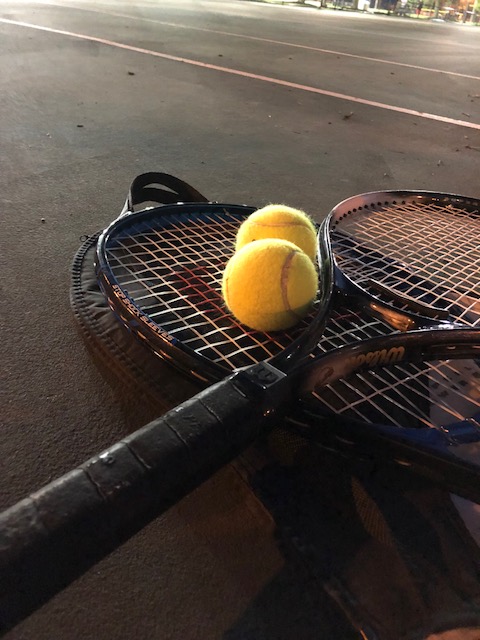
this summer is the summer of tennis for my wife and me. we don’t play too much, maybe once every 10 days, but that’s about 300% more frequently than we’ve ever played in a summer. that said, a couple of weeks ago, we walked over to our neighborhood tennis courts to play. we had waited a little longer than we should have, since it was already after seven o’clock when we left the house and that pre-twilight phase was quickly approaching. but that didn’t stop us from playing.

past the playground, the sprinklers, the field house, the basketball court, we walked to the farthest court, the one bordered by the busier street right next to the men’s softball league game, put our racquet covers and ball canisters and bags next to the net, and strode out to the baselines to hit back and forth. as we chased the balls and swung our racquets the sun set fully and dusk fell. the softball game continued behind me, with the sharp thud of bat hitting ball, infield sand crunching under feet, and yelps and claps when a runner made a go for a stolen base. the field lights and street lamps threw enough light for us to keep playing, although the ball would disappear from view for a couple of seconds on its way over the net, lost in the glare. regardless, we played on. and I began to notice that I was playing tennis differently, not just with my sight and my body following along, but with my whole body — or at least more parts of my body — attentive and alive to the ball. I was looking intently for the ball when it disappeared into the glare, but I was also listening for it, almost trying to feel the wind of it, feel it bounce on the court. sometimes I would just run in the direction of where I imagined the ball would bounce and trusted that when I swung it would be there.

people and their shadows walked by along the busy street beside us, on the sidewalk behind my wife, their shapes getting darker and denser as the night drew in more deeply. the ball began to glow in the little light that it caught, and disappeared just as quickly. my wife and I took a break for water and considered stopping, but we thought why not just a few more?

IMG_0078.jpg

and there was strange magic in our night tennis. we played as shadows, in the shadows, running after the shadow of a ball, using our senses and imaginations, not caring about the outcome, the night inviting us into another way of playing.

as strong as the weakest link, or run your own race?

lately, some of the adages I’ve heard since I was very young are really starting to resonate with me — I’m really starting to get them, and it’s most frequently been in the context of the classroom.

You’re Only as Strong as Your Weakest Link

this one used to annoy me a lot as a kid, in pretty much any group situation. in the settings where I was a stronger link, most often at school, I was easily impatient with and frustrated by “weaker links,” kids who didn’t get things as quickly as I did or who didn’t do their homework or try as hard, or whatever it was that in my child brain didn’t measure up.

as an adult, and especially as a teacher, I see now how each kid coming to school may be pushing as hard as they can, but the homes they’re coming from may either create obstacles or lay fertile ground for their school success. and that home life variable can be anything from poverty, not speaking English at home, having only one parent, having parents who are splitting up or who argue and fight often, to parents who are college graduates and earn high incomes and take their children on enriching vacations and hire tutors and nannies and send them to club sports and private lessons. it’s easy to grow when you’re a kid from an optimal home — or on the optimal side — versus kids who live in obstacle-filled homes.

I can see that now, and I can see it better, and I understand why I was impatient as a kid. and I know that I was guilty of thinking that I was smarter than other kids in my room. however, no adult — no teacher or parent or family member — ever broke it down for me, explaining that not every kid has the same home life. not every kid gets their own, quiet room to sleep in at night. not every kid gets a home-cooked meal and a place and time to do their homework. not every kid gets vacations to destinations around the country and around the world. and not every kid has parents who are genuinely interested in their success. so what can I do, now that I’m in a position to be that adult who can break it down for different groups of kids? — but not do it in a way that says, “Hey, you’ve got nothing, you’re our weakest link,” or “Hey, you’re so lucky, congratulations, you’re our strongest link?”

my best attempts have been trying to show it through biography and stories — to discuss how real kids from history, like Louis Braille and Helen Keller, had different childhoods, but through their circumstances were able to achieve a lot. I felt a little weird explaining it to my students at the time, but it was true and I think I had to say it. I said, “you know, if Helen Keller’s family wasn’t a wealthy, landowning family, we would probably have never known who she was. her family wouldn’t have been able to pay for a teacher to come and live with her, to give up her entire life to teacher Helen, and only Helen, for her entire life. it makes a big difference if you’re rich, and Helen was lucky.” I paused and thought, then went on. “and Louis Braille didn’t come from a wealthy family at all, so they had to be strict with him and give him chores and not help him too much even when he made mistakes. they had to see him fall, and then tell him not give up, or let him become spoiled or hopeless. they had to push him hard and he had to push himself hard, too. thankfully he never gave up, and we have braille today, and we have him to thank — and Helen Keller has him to thank, too. so we have to remember that our families help to push us hard and even our teachers are here to push us hard, too.”

So my role as teacher, and as adult in the world I guess, is to notice those people around me who are dealing with obstacles and setbacks, to acknowledge that and not to see them through a lens of strength or weakness, but through the lens of needing my understanding, encouragement, and support.

Run Your Own Race

my internal struggle then comes from the balance I try to find between caring for my students who need the understanding, encouragement, and support and also caring for my students who are already fortunate enough to come to school with a lot of the “optimal home life” boxes checked. between these two groups, what’s fair?

honestly, I don’t know. this is a struggle I’ve had for years. I have only so much time, so many resources, and so much energy, and I have to work with what I’ve got, sometimes moment to moment, and with a lot of variables at play each day. and for me it goes down all the way to the question of what a free and appropriate education is — what that truly means. does that mean that each child is challenged and engaged at their individual level for as much of the day as possible? does that mean that children are asked to learn the content of their grade level (first grade, second grade, third grade, etc.) and anything beyond that is extra? does it mean that kids need to be divided or tracked, so kids with more similar needs can be together? does it mean that kids cycle through different teachers throughout the day, so they can see specialists for each content area?

I know what’s plausible for me as a teacher, and I’ve heard what’s fashionable and preferred by parents, which — spoiler alert — are incompatible. so what do we do? most importantly, I think parents need to adjust their expectations, and think back to when they were kids. think back to what their teachers did for them, what their parents did for them, and then what they were expected to do for themselves. because in the end, we are running our own race, each one of us — and we have been all along — and kids’ teachers and parents and supportive adults are there to coach, model, and cheer them on, but ultimately our kids have to learn responsibility and they have to be driven by their own desire to self-actualize and get to their own finish lines.

are you living your best life? man, i’m tryin’!

what kind of person do i want to be? when i am on my death bed, or laying on the ground in pieces after being hit by a bus, and my life flashes before my eyes — what kind of person, and what kind of life, do i want to look back on?

i’ve been thinking about this a lot lately, because i’ve been housing a lot of regrets. and why? my life is out of balance — too much time at work, too much time worrying about getting things done, too much space given up to to lists of chores and tasks. and it’s taking a toll on me, self-esteem-wise and my happiness overall — even my ability to see good things, to register pleasure and joy. the stuff that makes up my heart and soul has been hard-packed by the trivial things in life and it needs some loosening up.

so — the things that matter to me most, that bring me the most joy, should be the things that should float to the top and be my priorities.

i think about this in relationship to teaching, which is a big part of my identity. i love learning and ideas. ideas — and just plain thinking — excite me, and i want to share that excitement with kids.

teaching, like life itself, should be part-structured and part rollicking and free. (we need to know where our next meals are coming from, but we can also have an adventure before dinnertime, you know?) as a teacher, as the teacher i strive to be, i am present to the kids, ever observant and open to them, their personalities, their problems and concerns, their foibles and idiosyncrasies. i am compassionate, but i push. i let them fail in a safe space, i ask questions, i sit back and think along with them. i wonder and i let the possibilities unfold. and even if it doesn’t happen this way most of the time, i want it to — i want to bring more of myself, the life enthusiast, into my classroom.

i think about teaching in relationship to living — the way they interact together, almost like the inhale and exhale of breathing — and i think forward to the inevitable moment on my death bed. so with the end in mind, i remind myself that i can be a good teacher — and a good life-liver — if i remember who i am, do the things that make my heart sing, and stay open to the fascination and terror and puzzlement and thrill that is living this messy life.