Can I be a housewife already?

I just finished watching The Marvelous Mrs. Maisel on Amazon and I loved it so much — engaging characters, funny dialogue, beautiful sets and costuming.

Anyway, something that I was vibing on while watching the show is the housewife lifestyle. I know it’s not very progressive or feminist or pro-women to say this, but so often I wish I could be a housewife. To be perfectly honest, the things I like to do best are the things that have to do with the home and “homemaking.” I like cooking and baking, I don’t mind running errands or budgeting and bill paying for the household, I love gardening and decorating, I get a good amount of satisfaction from cleaning, and I enjoy the process of planning and hosting people at our home for events and holidays. What can I say? I’m a house nerd.

However, with a full-time job that I often work 10 hours a day — plus a half-day most weekends — I’m not able to take care of the household as I’d like. My wife shares the responsibilities, of course, but it never seems that there’s enough time for us to do our paid jobs well, take care of the house well, and take care of ourselves well, too. During a good week we’re maybe 2 for 3, but hardly ever 3 for 3, you know? And I can see why, in the age of nuclear families, it makes sense to have one adult work outside the home earning the money and the other adult staying home to work that front. Because doing both can be a lot, especially if you want them done well. (And by “well” I mean not eating a grilled cheese or a can of soup every night for dinner or leaving laundry to build up to an avalanche-inducing height before I get to it…)

And this is not to disparage anyone who is trying their best to bring home the bacon and fry it up, too. I’m currently a member of that group and if anything I’m acknowledging that it’s damn hard to do both — it’s exhausting, actually. But, if I’m wishing to take a timeout from the breakneck speed of trying to do both work and home life, I can’t be the only one.

Which Is Better: Your Best or Good Enough?

Doing my best, trying my hardest, giving it everything I’ve got is a big part of my identity — especially when it comes to work. As a kid, school (the junior version of work) came pretty easily to me, but I would still try my hardest, study diligently for tests, strive for my personal best, look for ways to challenge myself, all that. Even in high school, most Friday nights I’d sit at my convertible dresser / desk, consult my meticulously written out homework agenda, and get to work. And it wasn’t because I wanted to get it out of the way to open up the rest of my weekend, it was because I wanted to feel that feeling of achieving and doing things well. Same thing in college, grad school, and on into my adult work life. Problem is, this work ethic and my perfectionistic tendencies have caused a lot of stress and heartache.

I’m currently in my eleventh year of teaching and sometimes I still feel like I put in as much time and effort as a rookie. Lately I’ve been reflecting on reasons why — and I don’t want to make excuses for myself — but from what I can see there are a few major factors, some that I can control and others that I can’t and never could have.

First and foremost, teaching is one of those professions that can become a 24/7 occupation. If I spent my full energy thinking about each of my students, their unique talents and needs, and then designed meaningful and personalized learning for each of them that in itself could be an endless task — not to mention developing a beautiful, enriching, and engaging classroom; creating attractive and interactive bulletin boards in the hallway; reaching out to all the kids’ parents regularly via their preferred communication method; continuing to develop my professional capacity with after school, weekend, and summertime opportunities; applying for grants and writing Donors Choose proposals; the list goes on and on and each task — when done to the best of my ability — could be a nearly full-time job on its own besides the task of teaching the kids who come to learn something with me everyday. So there’s that. Teaching is hard.

Second, my early career — and even my pre-service experience — was rocky at best. As a student teacher my cooperating teacher didn’t even know I was going to be with her (for the entire school year!) until I sat down next to her in August and introduced myself. Just imagine — she had had no idea that for the entire school year a 25-year-old was going to be shadowing her, observing her, and hoping to eventually take over her classroom instruction. She was also not the best model of how to teach creatively or use time efficiently. Just to give you some context:  she had 15 students and taught out of basals — essentially pre-written curricula in all content areas — and was still at work every day until after six o’clock at night reviewing lessons and wondering to herself what to teach. Once I got into my own classroom, the first four years were a different grade level, a different classroom, or a different school. First it was first grade, then it was a triple split with first, second, and third graders all in the same room, then it was just third grade but I had to move classrooms, then I was in a brand new school with no curricula at all and I was responsible for writing essentially all of it with a team of strangers. Phew! After that, I was in the same classroom teaching the same grade, but turnover at my newer school was so high that for four years the entire team was new each year — except for me — so I was responsible for guiding my new team members through curricula I’d written and then managing, revising and rewriting that curricula with each new team. So there’s that. Teaching is really hard.

All the while, through every major change, I felt very responsible for my students and an obligation to do my very best. Because the kids needed me and because doing a job well is an expression of me, of who I am as a person. It’s been a huge part of my identity to do things well, actually — if I want to be fully honest — it’s been a huge part of my identity to do things the best, to be the best, to be outstanding. And for many years I’ve strived to do just that and many times I’ve stayed at work 11, 12, 13 hours a day, working half-days on Saturdays and Sundays, and over breaks, too. I’m doing things “the best,” but when I’ve had those moments to step back and look at my life as a whole rather than just work, work is the only thing getting done — no time or energy for eating right, exercising, socializing. And now that I’m in my eleventh year of teaching, I’m tired. Because teaching is hard, and because it’s hard to give it my all, all the time, and in many cases for it to make not that much of a difference to anyone but me.

So this is where I am — stuck — and maybe in transition. Some days I leave my classroom feeling like a failure:  I have dozens of things left on my to do list and it’s unlikely they’re going to get done anytime soon. Certain lessons or moments didn’t go the way I planned or wanted, and I just don’t feel like I gave it my all. Other days I look around the room — mess that it is — shrug, tell myself I did the best I could with what I had, remind myself I have a life to live outside of work, turn off the lights, and leave.

And on those days, even though I’m gone, in my car on the way to the gym or home to cook dinner, looking forward to a new episode of Fixer Upper or another couple of chapters from a library book, there’s this nagging, needling feeling that keeps me wondering — is it okay that today was good enough, or should I have really tried my best?

Addicted to the Big Reveal

So this winter break I’ve become really interested — okay addicted — to an HGTV show called Fixer Upper. Despite this show, and this network really, being responsible for my wife and me thinking we could buy a building (and then we did) I still love this show. And what’s not to love?

There’s the typical goofy husband / beautiful wife combo who work with clients to make their dream homes become reality. There’s some silliness during construction, a peek at the Gaines’ growing family and their animals at Magnolia Farms. It’s great.

What I especially love is that Big Reveal at the end. Ooh, I just friggin’ love it!!! The couple is nervously laughing and their shoulders are all tense, or they’re grabbing one another’s hands in anticipation, and Joanna or Chip ask, “Are you ready to see your fixer upper?” and the couple says “Yes!” and then the screens are pulled away and then someone shrieks with joy, or the couple hugs, or they exchange handshakes or hugs with Chip and Joanna. It’s the best, that moment of unveiling and sharing after such a long time of waiting and hoping and wishing and dreaming for the day.

I love the moment of the big reveal because energetically, spiritually even, it feels like a big moment of exchange, of following through with all your promises and giving it everything you had, of showcasing earnestness and honesty, of having every good intention fulfilled and put on display, of giving and healing — healing both the home owners and the home itself. It’s the final moment of taking someone’s trust (and money, of course) and turning it into a newness that was previously only imagined in the mind’s eye. The home, the place where our bodies and minds come to rest and where our energy is replenished, is made new. It’s just so… — I just love it.

And in some ways, New Year’s Eve feels like that, too. Tonight is the big reveal on the new year, on the start of 2018, something new and fresh. It’s like a backyard full of freshly fallen snow, and no one — not even a sparrow or a stray alley cat — has stepped foot on it yet. It’s blank, and the potential seems endless.

The tricky thing is what to do — and how to live — once we get that clean slate, that do-over, that moment of starting anew. I know I’ve had many Mondays where “this is the week that everything will go just the way I want it,” and of course it doesn’t — because life is a messy organism. And after one fail I wait for the next Monday, and it turns out that over the years I’ve spent a lot of time waiting to start over.

So I go into this new year focusing on the big themes I want to heal and make new — no, not make new — just see and live in a new way. Because we all have lives that are just like these fixer uppers — the bones are good and the potential is there, we just have to see it in ourselves and then lovingly, day after day, choose the path that creates change and fulfillment — one little Big Reveal at a time.

Christmas Shopping & Gender

This past Friday I was about 1% prepared for Christmas in all of the possible ways:  no gifts purchased, no decorations hung, no cards written, no cookies baked. But it was on the list of things to do for Saturday and my wife and I really got it done. At some point I just decided that this year all the adults were getting socks and all the kids were getting books, so I think that helped. Sorry, family members, if you’re reading this. Maybe I should’ve put a spoiler alert at the top for you. Either way, let’s move on.

Besides the socks and books, my wife and I did some other in-person shopping and as we zigzagged between the boys’ and girls’ clothing sections the contrasts were pretty stark. Thankfully a boy I was shopping for only needed clothes in navy and hunter green — but if he had wanted anything in an even slightly peppier hue, it would have been a challenge. At one point I stood in the tiled aisle facing in towards the clothing racks, boys’ side on my right and girls’ side on my left. The girls’ side looked like a a balloon had just popped and as many sparkles and frills as you could imagine rained down in colors like pink, soft purple, white and yellow. Since it’s Christmastime, there was also a good mix of red, green, and black, but when my eyes moved over to the boys’ side, it was like all the color had been leached out. Gray, navy, hunter green, black, more gray, a few spots of white and royal blue. That’s it.

And what does this tell our boys and men? Because it’s the same thing when I walked the women’s and men’s sections, if not even more pronounced. Women’s racks were strewn with dresses that looked like silver and gold disco balls and the men’s racks had black, gray, blue, dark green, more gray. Just looking at color, and not even more detailed things like fit or design, to me it looks like boys and men aren’t supposed to have any fun. They’re not supposed to see their bodies and their clothes as a way to express themselves, to be viewed in a decorative or showy way, to play with color, pattern, or texture.

To me this small detail, a wardrobe drained of color, portends that men cannot have — are not culturally allowed to have or are not “supposed” to have — a relationship with their own sensuality. Think about it — when you picture a “bachelor pad” in your mind, what do you see? Over the years in person and in media I’ve mostly seen hyper-minimal looks, lots of black, white, gray, and stainless steel, maybe some raw or dark wood, maybe some sports memorabilia. Colors are often bland and dark. It’s often feels hard and in many ways lifeless. Sometimes even a bit cold and empty.

And what does male clothing or home styling have to do with anything? Well, we’re having this national “moment” about men and their bad behavior towards women — not all men, but enough men towards enough women that it’s made its way into many of our daily conversations. It makes me wonder:  if these men, who were once boys, had been allowed to get in touch with the full range of their sensuality by playing with color in something as mundane as their clothing, what would have happened — what could have happened?

If men had had the chance, the permission, to wear yellow, orange, purple — gasp! pink! — what would that have felt like? Would it have sparked a change, a tiny shift, into asking the simple question:  What else? What else can I feel? What else can I experience? And what if the what else didn’t end with color and clothing, but with putting aside other hyper-masculine attributes to explore something else, another side of who they are and another way of being in the world? What if they asked what else when it came to expressing affection? What if they asked what else when they wanted to express sexual desire? What if they asked what else — how else can I deal with this — when they felt sad, lonely, rejected, isolated, unattractive, unwanted?

Because beyond being male, each individual person, regardless of sex or gender, is so much more — and there is always something else, something more to explore, something more to see, another shade or angle to experience.

And if you’re a man or identify as male, it’s very likely that if you’re like most of the men I know:  you haven’t had a chance to explore your sensuality, your creativity, your way of being in the world that isn’t highly dictated by very strict masculine norms. And what a thing — to miss out on all the shades of life. How dull. How boring. How gray.

Taking Things Apart

About two weeks ago, I came home from work to see my mom and wife preparing to take apart the pipes under the kitchen sink. The sink had been draining slowly for a few days and she had decided to call my mom, who knows a few things about home maintenance and repair, so that she could learn to do it herself. Three hours later, after a trip to the hardware store and a few breaks to just stare at the mess we’d made, the sink was put back together and draining just like it should. The process, though, was very uncomfortable for me. Partially because I didn’t know that The Kitchen Sink Project was going to happen, and partially because I feel very uncomfortable with taking things apart and making a mess.

In part some of my discomfort — that borders on dread — stems from my upbringing. And what better way to get to know myself and my childhood hardwiring than to throw myself into new or uncomfortable situations? My mom liked a very orderly, neat and clean house. And I don’t blame her:  she was a single mom with two kids and she had to go to whatever lengths she could to make sure we were clean, clothed, fed, and educated. As a result, keeping a tight schedule and an orderly home was the cornerstone of my childhood. Neat and orderly is generally a good thing, but sometimes there can be too much of it.

I remember as a kid, probably around 10 or 12, I felt inspired to draw, so went to take out some art materials. I opened up the cabinet and reached for the little plastic watercoloring set that we had had for years, but at the thought of having to control and then clean up the mess, I stopped myself. Rather than deal with the burdens of mess and clean up, I chose to avoid it. I chose to do something else instead. And that wasn’t the only time. As I grew up if I could do something cleaner, tighter, more contained, I chose that option. I systematically began to avoid messes, experimenting with materials, taking things apart, getting dirty.

IMG_3314

Odds and ends from the tool closet.

The philosophy of staying need, tidy, and contained continued at school, too. When it came to those typically messier, more hands-on subjects like art or science, my teachers trotted out the easiest possible options. Paper and pencil drawings in art, maybe occasionally something like paper mosaics with construction paper and glue. And for a real treat, drawing with oil pastels or chalk on paper. In science, work mostly revolved around textbooks — books we couldn’t even take home to read, because in middle school there was a set of 30 for about 90 of us. In fifth grade I got to dissect an owl pellet, but I think my teacher only got five or six, so we had to share in groups of five or six. For me as a student, explorations meant looking on from a safe distance — from behind glass at a museum, by looking over my grandpa’s shoulder at his workbench, by wondering in my head and just leaving it at that. Maybe sometimes I’d look it up in a book.

And what does this mean? In part I see that it makes me really aware as a homeowner that I am uncomfortable with fixing things, with taking things apart, and making them work again. I’m afraid to make a mess. Partially because there’s the nuisance of cleaning up afterwards, but also because I’ve never really dealt with this kind of mess before. I haven’t had the chance to explore under someone else’s guidance. And as far as the house is concerned, I’m both child and adult as I begin this process of learning. I’m leaning how things work, I’m pushing myself to explore pieces and parts of the house and how things go together, I’m trying to build the belief in myself that if I take something apart I will have the know-how to put it back together again.

That experience with the sink was small, but empowering. With some perseverance, a little willingness to experiment, some coaching from my mom and encouragement from my wife, I did it — actually my wife and I did it. And afterwards I felt that click in my head, that particular part of my body and brain turn on and get excited. I felt the rush of doing something real for myself and my house. And as a teacher it made me want to bring that rush of excitement, that kind of learning experience, to my students.
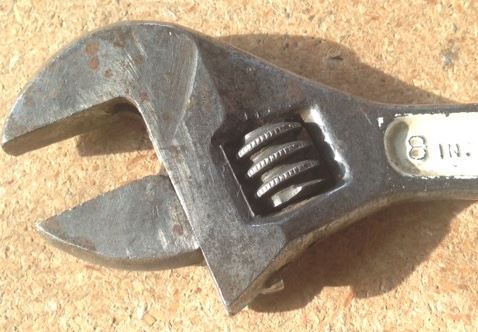
IMG_3316

My grandpa’s tool, now mine.

Because truly, how often do they get to explore and play — and with something that can eventually become real and meaningful? Culturally I see that there’s a push for kids to be “college and career ready.” And as a teacher I believe in education. Of course. But the obsession with college and “good jobs” is, frankly, bullshit. We see that the most recent generation of young adults is deep in college loan debt, to the point of being paralyzed by it. And in many cases, I see that people don’t know how to do. Generally speaking, we don’t cook for ourselves very much, we don’t fix things for ourselves, we don’t make or manufacture things for ourselves. Because — didn’t you know? — that’s someone else’s job. Somewhere along the line of pushing our children to be college and career ready we began devaluing and distancing ourselves from the valuable work of taking things apart, fixing things, and making them work again. Which to me is one of the most real things a person can do. It’s a tangible example of our realness and our power in the world outside ourselves.

And as I get of taste of my own realness, my own power to fix and make things, I see that I’m starting to question things. I’m asking, how does this work? How is this put together? Why does it work like this? Is there some way to make this better? Where does this come from? Can I fix this? What can I do to change this? And if I’m asking these questions after fixing one little ole sink, what kind of questions would our kids start to ask themselves when they have a taste of a something similar?

And if I see that I have the power to question, to take things apart, to get messy, to put things back together in a way that makes them better — and to clean up the mess, too — then I see that I can be powerful in other ways, too. And when “powerful people” want to tell me that they’re right and I should fall in line, I can stand in the knowledge of my own power and push back. I know that I don’t have to avoid taking things apart or to making a mess. I know now that I have the power to fix it. And I want the same confident stance for my students and for the future adults of our planet.

IMG_3320

An assortment of inherited and newly purchased tools: vise grip, wrench, pliers.

There is beauty and power in being real, in being here  and doing things that are visible and tangible, things that concretely alter and improve the landscape of our lives. So let’s take things apart — from the humblest kitchen sink to the way we view ourselves and our places in the world. Let’s get messy and work on it together.

Was I that kid?

The classroom is most definitely a microcosm of society. Just like in “the real world” — also known as the world outside the classroom — there are moments of imbalance and injustice. What I’ve been struggling with and turning over in my head the last few weeks is what I can do about it, both as the adult in the room when I’m teaching and as a person in the world when I’m not.

Columbus Day just passed and I was going to say something about that, something about how it’s a bullshit day, that it should really be a day to honor the African Diaspora and the First Nations People rather than the conquerors. Then I was going to say something about facing the reality of our American culture, that many of the most “American” things emanate from non-white people and non-white places, ranging from the music we listen to to everyday technologies we take for granted.

But that statement alone wasn’t going to be enough; this nationwide, even worldwide negligence of balance, truth, and justice is part of it for me. It’s part of my slowly roiling frustration when I’m in the classroom this year. Another part of it is that now that I’m working with white kids — my first time in 11 years of teaching — I’m now seeing my biases up close on a daily basis and I’m seeing how extremely fucking sneaky they are, and worse yet, how little innocent white kids rely on them, base their entire stance in the world on them — and how adults like me perpetuate the cycle.

And so I arrive at a buffet of doubts and questions. Was I like these white kids when I was a kid? Did I take up so much space with my whiteness and the privileges it brings that I left no space for anyone else? Did my entitlement over-magnify me to the detriment of my peers? Did my implicit expectation that of course I’d win or get what I asked for or be chosen or go first take that experience away from someone else who was just as deserving — or more deserving? Did I just go through most of my life thinking I was a sweet girl in grammar school, friends with everyone, darling to all, while my classmates were just waiting for me to leave the room so they could finally breathe and take up some goddamn space?

I’d love to believe that I wasn’t like that. But maybe I was. Maybe I did take up that much space in the classroom, in the teacher’s psyche, in my classmates’ mental and emotional space. And with every inch I took, every time I raised my hand, answered a question, made some subtly domineering move in the classroom, my non-white peers got just that much less space for themselves, for their self-expression, for their self-exploration, for their risk-taking, for their leadership, for their ideas, for their questions, for their existence.

And there’s nothing I can do about it now, unfortunately, no way for me to go back and fix it, fix myself, teach my younger me how to not be an entitled jackass kid. But what can I do now? What can I do?

Well, I have to see this as my chance. I get to be a defender and a bridge and a guide all at once. My job is to guard the classroom space, keep it clear and open for all of my kids to lead, question, grow, take risks — to defend all of my kids’ rights to experience education, the act of learning and engaging and growing past their current boundaries. My job is to bring these kids together, bridge their differences, draw them close together and set up the expectation that they will always mingle, always integrate, always know one another, and always wish to know one another. My job is to guide them through rich and diverse materials, highlighting the beauty and value in everyone, in all of us, honoring our shared humanity. How exciting. How terrifying.

I acknowledge that I’m going to fail, and do it wrong, and forget myself and give in to something deeply coded into my brain. But I’m trying to push through my own shit to open up space and keep it open, one inch at a time.

Life Is a Grassroots Campaign

Last week I wrote about my appreciation for my body, for all the things that it allows me to do. That appreciation still holds, but I’d like to go into it a little further; with all things simple, there is a lot to be mined from the depths.

I grew up studying ballet, a discipline which in general teaches its students to have anything from a mild distain to a full hatred for the body — usually because it’s not meeting the ideals of the ballet physique or the standards of what a body should do and how it should look doing it. If you want to seen an example of just how much ballet can skew your self-concept, take a look at this Russian ballet superstar.

In addition to ballet, add the fact that I’m female. The pressure to act and look pleasing  is so subtly pervasive, it’s like a mist in the air; you know there’s something there, but you just can’t quite put your finger on it. Then, compound that with female competition — who’s the most pleasing, the thinnest, the smallest, the prettiest — and I was swimming in a pretty chunky self-hatred stew. The trouble is, like I mentioned, it’s so pervasive and so common — and starts at such a young age — that I wasn’t even fully aware of it until I was well into womanhood.

I left ballet towards the end of high school — I wasn’t going to be good enough to be

IMG_3222

Found in the lot next to my building. Reminds me of the stinky onion of self-defeat.

professional — and even though the physical training had ended, the mental training of ballet stayed. There was some good in that training:  I was very goal-oriented, self-disciplined, extremely respectful of authority figures and teachers, I had a lot of body awareness, and strangely good peripheral vision. But I also retained heavy self-judgment and self-doubt, I was perfectionistic, and I could hardly ever acknowledge that I was doing a good job, let alone doing “enough.” And these characteristics made it hard for me to be good to myself as a college student and a young adult. These characteristics also made it hard for me to be good to the people around me.

What does all this have to do with life being a grassroots campaign? Yesterday I was listening to a podcast with Mike White, a movie writer and director. The topics he discussed were wide-ranging, but mostly focused on people’s jealousy and obsession with status. At one point he said, life is a grassroots campaign; we start with ourselves, in the body that we’re in and the dirt that we’re standing on, and from there we build out to the people around us.

And I realized — intentionally or not — that’s what I’ve been doing since the day I left ballet. I’ve been working to let go of the self-judgment and self-doubt, the perfectionism and the idea that I am never enough. I’ve been loosening my grasp on “perfect,” and reframing my life around growth and self-forgiveness. A small, quiet, tiny but profound internal revolution.

IMG_3221

I ask myself, are my health and body perfect? Definitely not. But can I see small changes  when I go to exercise, when I make a choice about what to eat, when I ask my body to do something challenging and it rises to the occasion?

I ask myself, is my job perfect, is this the job I want forever and always? No. But am I growing and changing through this job? Am I thinking of how I can use it as a bridge to develop into what I want and who I want to be professionally?

I ask myself, is my marriage perfect? Sometimes yes, but not always. But is it growing and changing with who we are? Are we approaching a life together focused on mutual love and support?

I ask myself, are my friendships and family relationships going the way I want? Mmm, it depends. But can I see how approaching a person with compassion and optimism can strengthen the ties we already have?

Can I see how my loving treatment of myself can build momentum, turn into a ripple and then a wave, and that over time it can radiate outward? And can I see that eventually I am the head of my own grassroots movement — one that is rooted in recognizing and cheering on growth, change, forgiveness, optimism, and resilience?


Thank You, Body

This week, again, was spent working in my classroom so what I planned to write about got a little derided. However, I think the things I’ve been thinking still apply. So, here we go.

Even though I’m female and I’ve been raised in an American culture that encourages girls and women to be their biggest critics — and even despisers — of their bodies (too fat, too skinny, too tall, wrong hair, wrong skin, blah blah blah) I love and appreciate my body so much, especially in weeks like these.

My body has been my lifelong companion. I mean, duh, obviously, but really — think about that — your body is the only living thing that will be with you your entire life. Not your parents, your siblings, your spouse, even friends or pets. Maybe a tree or a sea turtle, but for argument’s sake let’s just say it’s just you inside your body. And the fact that your body is alive and functioning means you’re alive and on this planet, living a life. Your body is your host and home for the life you’re living and simultaneously it’s a living organism with needs — just like any other living organism. And the profound thing is that this body is yours — and my body is mine — and that body goes with me and does pretty much whatever I ask it. Get up at 5:55am everyday? Okay. Walk briskly and stand in lines and carry heavy boxes and lift bins overhead and climb a ladder and get down from a ladder? No problem. Go five, six hours without food because you’re busy? Well, why not. And in some ways this is an everyday miracle. The fact that I can do and do and do and think and do some more — all while nearly forgetting about my body, having my body be a transparent tool that does whatever I want it to do, is a tiny miracle. And I am so grateful — my body is strong and loyal.

But loyalty reminds me — I have to be loyal, too. My body, my beautiful, miraculous, ever-giving body, needs some loyalty and care, too. Just like any other type of companion or friend, the relationship I have with my body needs maintenance. The basics, yes, like sleep and rest, nutritious food, clean water, a good dose of rigorous exercise — but also love and appreciation. I really do believe that my body, just like any other living organism, can feel the energy of love and appreciation and flourish in that love — and conversely — the energies of dislike, disappointment, frustration, irritation, shame, disgust can bring a body figuratively and literally to its knees. So why not just do it? Feel love for the body — for your body.

Because even when the body gets sick, when the body gets tired, when it falls short in some way that you deem, it’s still there for you, working for you and doing its best to keep you living — so that it can be the tool you need to live the life you desire. What’s not to love about that?

Creative Spaces

This week I spent most of the week driving around Illinois for the solar eclipse, celebrating my wedding anniversary, and also putting my work space together.

Over the last three days I’ve spent about 20 hours setting up my work space, my classroom. Every year in the late summer the room starts as a fairly blank canvas, all the furniture needs to be moved around, books and materials need to unearthed and a place found for them. Lots of thinking and rehearsing and trial and error goes into all of this; it’s not just about how I’d like the space to look and feel, but how 30 kids will like it, how they’ll feel in the space. I think about whether the placement of something is intuitive, too high, too far away, if a walking path is clear and uncluttered, if a rug’s location looks inviting, if I will be able to reach for something easily or I’ll have to hang over the side of a desk or bookshelf to get there, if the afternoon light will be too bright on a desk, if the room will be too gloomy on a cloudy day, if there’s a comfortable place for me to sit when I’m alone working, if there’s an obvious place for me to gather with groups.

IMG_3210

The room in its before state. There’s no after picture just yet.

Is all this necessary? No, not really, and I don’t mind. But I used to mind. Every August I’d start to dread going back to school. It’s not fair, I used to think. I’m not getting paid for all this work, all these free hours. But something this summer shifted. I’ve realized — embraced, really — the fact that even this kind of work — moving books and hauling furniture — is creative. I’m creating a space that will stage all kinds of further manifestations of creativity:  ideas, discussions, projects, posters, friendships, experiments, and more cycles of trial and error. This time of year is my chance to create and curate another part of myself — the physical space that hosts my professional life. So I go back to work knowing that creativity has many faces, that I can let go a little more, and get lost inside my creative process in an old space that, this time around, is feeling brand new.