Read Aloud Series, Book 6: A Series of Unfortunate Events – The Bad Beginning

Ah, how I love to read this book aloud. So many fun voices, especially for the evil Count Olaf and kindly but mostly ineffectual Mr. Poe. There are lots of literary references that the kids don’t necessarily get (e.g., Mr. Poe, the Baudelaire children) but I like to know that whenever I pick up this book, those winks to the adult reader are lurking. Speaking of lurking, the book’s tone is so distinctly dry and gloomy it really pulls the kids who are listening into the world of the Baudelaire children – a world of danger and uncertainty.

But let me back up to the bad beginning. There are three children, Violet, Klauss, and Sunny. Their parents are killed suddenly and so they are left orphaned. Mr. Poe is the executor of their estate and, following their parents’ written will, they’ve been sent to live with their closest living relative, Count Olaf. As the story progresses things become more dire for the children and include a daring escape from a tower and outwitting the villains with an ingenious ploy.

As we read, students wonder about who will save the Baudelaire children and how no adults have noticed their distress. Throughout the novel, Violet, Klauss, and Sunny work together and live by their wits to maneuver through their difficult circumstances. Ideally the children listening feel the tiny seed planted that suggests that they too can save themselves if the going gets tough.

Time and again I return to The Bad Beginning for adventure, for excitement, and a chance to tap into the students’ imaginations – for their minds to imagine themselves as the heroes of their own stories – and for the pleasure of introducing them to the first in a long series of books about the Baudelaires.

The Bad Beginning at 57th Street Books

The Bad Beginning at Semicolon Books

Read Aloud Series, Book 5:  The Miraculous Journey of Edward Tulane

Oh Edward. He starts out as such an unlikeable character:  a three-foot-tall, white china rabbit with a full wardrobe, complete with footwear and hats. He’s also unrelatable since the kids don’t really play with those types of toys anymore. That’s where my own read aloud and storytelling comes in, and I sell it to them a little. They eventually get into it. 

Edward is lost at sea, buried in garbage, thrown from a train, and saved from the brink of death. Like Frindle, there is another wonderful twist at the end that has big payoffs for the kids — and they really react when it comes. There’s also a lovely one-page Coda at the end that recaps the entire story plus a little fast-forwarding, which helps to remind the students of Edward’s full journey, inside and out. 

One of the best quotes of the book:  

“I am done with being loved,” Edward told her. “I’m done with loving. It’s too painful.”

“Pish,” said the old doll. “Where is your courage?”

This is a story that slowly and gently unfolds. It’s about love and regret and finding our way home. 

The Read Aloud Series is a review of the series of books I used to read aloud to my third grade students every year after lunch. The exact order and titles changed somewhat over the years, but these are the ones that were most beloved, both for the kids as listeners and for me as the read aloud reader. Many afternoons our 15-minute read aloud time would stretch into 20, 30, sometimes as long as 45 minutes, as the kids begged to hear more of a story, or we discussed what a character did, or I reread difficult passages, or diagrammed family trees and plot lines for them. I can say that my gift as a teacher was, and still is, my enthusiasm for a good story, and these are the books that have brought me a great deal of joy in sharing with young readers over the years. 

Read Aloud Series, Book 3: Clementine

Book 3, Clementine

This petite book by Marla Frazee shows that girls can be Bad Kids, too. Clementine is wildly distracted and wildly creative and caring and silly and so youthful and innocent. She is a little bit manic pixie dream girl, but in a mostly harmless and very childlike way. Because Clementine is a child. She makes so many mistakes and is so much herself that through the opening chapters the kids at first are confused by her:  cutting off all her friend’s hair, then her own, then trying to fix it with red permanent marker, eating peas with a toothbrush, naming her pets after cosmetics products. Clementine also deals with loss and longing in a way that gently opens that conversation for the kids. It’s very silly and also disarming and real. 

Clementine creates a way into building curiosity and patience for a character, into experiencing the truth of the narrative before the protagonist does, and then waiting to see when and how she finally catches on. It sheds some light on how to love our friends and family members, even the most maddening ones, with generosity and curiosity. It shows how we can treat a Bad Kid with gentleness and acceptance and humor. Because we all make mistakes, and we have all wished to be embraced for who we are, and not just tolerated.  

The Read Aloud Series is a review of the series of books I used to read aloud to my third grade students every year after lunch. The exact order and titles changed somewhat over the years, but these are the ones that were most beloved, both for the kids as listeners and for me as the read aloud reader. Many afternoons our 15-minute read aloud time would stretch into 20, 30, sometimes as long as 45 minutes, as the kids begged to hear more of a story, or we discussed what a character did, or I reread difficult passages, or diagrammed family trees and plot lines for them. I can say that my gift as a teacher was, and still is, my enthusiasm for a good story, and these are the books that have brought me a great deal of joy in sharing with young readers over the years. 

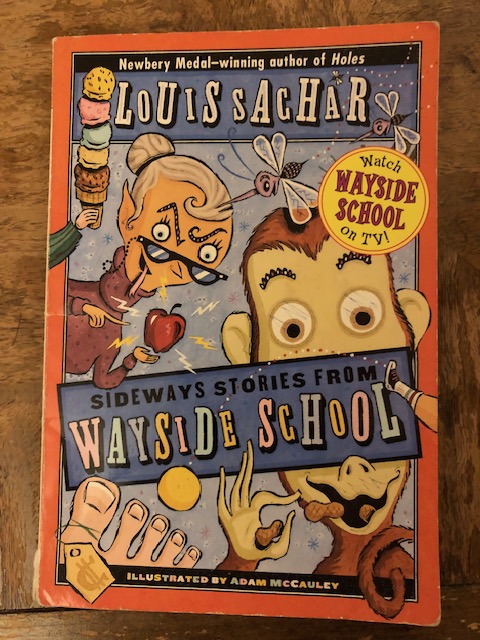
Read Aloud Series:  Book 1, Sideways Stories from Wayside School by Louis Sachar

First book. Twenty minutes after lunch and recess, a time to re-civilize ourselves. Sit and breathe, then ring the chimes three times, then try to settle and manage listening outward while imagining inward. A test. An exercise in patience and, eventually, if I’ve laid enough groundwork, a practice in developing the mind’s eye and also precious sensitivities like compassion and humor and wonder and curiosity at what it means to be a human in a hard world. It’s just stories, they might say. Is it? Stories make worlds. So I start with this first book. It is silly, sometimes absurd. But they love the voices I make and that the mean teacher sees justice (of a sort) and students fall out windows asleep and almost sell their toes and are right about the wrong things. Each character a child with their own uniqueness to offer — just like them.

Short chapters that do a lot of work. They capture and recapture attention page after page. Lots of laughs and silliness, a sign that books and words can be play and not just labors to get through. It does the trick, this book. Placed in the library when completed with the class, I’ve seen it with a front cover falling off and pages bent and fingerprinted with chip dust. Loved and used till it must be replaced. Again and again. And we are a little closer to loving reading and story as much as I do.

The Read Aloud Series is a reflection on the series of books I used to read aloud to my third grade students every year after lunch. The exact order and titles changed somewhat over the years, but these are the ones that were most beloved, both for the kids as listeners and for me as the read-aloud-reader. Many afternoons our 20-minute read aloud time would stretch into 25, 30, a few times even as long as 45 minutes, as the kids begged to hear more of a story, or we discussed what a character did, or I reread difficult passages, or we created family trees and plot diagrams on the board to keep track of it all. I can say that my gift as a teacher was, and still is, my enthusiasm for a good story, and these are the books that have brought me a great deal of joy in sharing with young readers over the years.